Showing posts with label animal welfare. Show all posts

Tuesday, April 18, 2017

A Sanctuary is Not a Petting Zoo!

As warmer weather approaches, sanctuaries that provide a permanent refuge for rescued farm animals are inundated with requests from people wishing to bring their young animal-loving children for a visit. Many envision taking their wide-eyed, excited child into a pen of loving, friendly animals who will let themselves be endlessly petted and cuddled and hand fed. This is, after all, the image they have seen in advertisements for commercial petting zoos. But a sanctuary is not a petting zoo. 


According to the Oxford Dictionary, a sanctuary is a place of “refuge or safety from pursuit, persecution, or other danger”, and “a place where injured or unwanted animals of a specified kind are cared for”. 

A petting zoo, on the other hand, usually buys young adult animals in the late winter or early spring, often from questionable sources with little regard to genetics or potential health issues. Then the petting zoo breeds them, puts them on display almost immediately, and lets excited kids with grabby hands stress both the babes and the mamas. Visitors are usually allowed – or encouraged – to feed them as well, regardless of how much the animals may have already eaten that day. Often the babes will be weaned and separated from the mother at the earliest possible age, in hopes that a second birthing will be possible before the end of summer, ready for the popular harvest money-makers like hay rides and corn mazes and pumpkin patches. 


Pumpkin patch?  I wouldn't mind visiting a pumpkin patch! 


And when the season is over and the money is no longer rolling in? The animals at most petting zoos are then sent to slaughter or sold - after all, by next tourist season they will no longer be babies that draw in the crowds, and feeding adults or youngsters through the winter months in order to breed them in the spring costs money. It's cheaper to dispose of the animals and buy new breeders the next year.  

Does that sound like a sanctuary to you?


Don't be a turkey!  That ain't no sanctuary!

At animal sanctuaries such as RASTA (Rescue And Sanctuary for Threatened Animals) in nearby Chemainus, the animals are residents who will live out their lives at a place that treats them with dignity and respect. It is a place that will not exploit or sell them, that will not breed them, and it is a place that will provide them with a safe haven for life.  


Garfunkel:  I hear strangers nearby - let's circle the wagon!

Tango and Romeo:  Why?  Is there food in it? 

Most of the animals have arrived at the sanctuary after pretty horrible lives – passed from home to home, or abused, or abandoned, deprived of appropriate veterinary care, and/or confined without companionship of their own kind or others. Many have significant health issues that require special diets and medications. Their food intake is carefully managed, in both quality and quantity, to ensure their nutritional needs are being met appropriately. This is not to say they don’t get regular treats – they certainly do – but not every time someone walks nearby. 


Excuse us!  We're having a snack!

Because of their varied and unfortunate backgrounds, some might bite or shove humans, some might have poor eyesight that mistakes a child’s hand for a treat, some might not have the dexterity to ‘take gently’ when food is offered. Even the scent of an unfamiliar human can make some animals who are normally friendly and even playful with regular volunteers retreat and/or become anxious.   

Help! Help!    There's a stranger in our house!


Oops, sorry, was that your finger I just chomped?

See these horns?  I'm really a gentle giant but if a fly tickles my tummy
and I swing my big head around to shoo it, you better shoo too! 

To be sure, many sanctuaries do offer tours at set times and days, nearly always by appointment only.  At RASTA, these educational tours (which include a presentation on factory farming) are restricted to very small groups on only one or two days a week so every person can be closely supervised and so the animals are not overwhelmed. 

Because sanctuaries give as much freedom as possible to their animals by allowing them to roam around with their animal friends in pastures or extra large fenced pens, safety – for visitors as well as for the animals - can be a challenge. Sanctuary volunteers have to make sure all visitors stay together, ensure no one sticks out a hand to an animal that might mistake it for a carrot, see that no one gets knocked down or left behind or wanders off, no one leaves a gate open or drops an inedible item in a pen. There can be no lollygagging to send a selfie to your friends while your group moves on to the next pen!


Oooh, looky here.....someone left the door open!

A plastic bag!  I found a plastic bag in here!

On an educational tour, discussion about the animals’ backgrounds and about animal treatment in commercial industry is not always suitable for young ears and may even upset sensitive adults. It is not a 'cute-fuzzy-wuzzy-let’s-go-feed-and-pat-the-animals' experience, though you may be lucky enough to be there when some of the more social animals wish to interact with you. But the decision is up to the animals, not you, and if Sociable Suzie decides she’d rather have a nap buried in the soft straw in her shelter, then Sociable Suzie gets to do just that.


No, thank you.  Not today.
 ^What she said ^ 

If you wish to take your kids or grandkids to the local petting zoo this summer, that is your choice. If you think your children are old enough and mature enough to visit a sanctuary, by all means request (well in advance) an appointment for an educational tour. But please don’t expect the same experience at a sanctuary as at a petting zoo. 


This is the animals’ home. This is their sanctuary, their safe space, their forever home. This is not a petting zoo. 


And now you know. 

Saturday, November 7, 2015

The Courage to Rescue

RASTA, the nearby sanctuary where 13 pigs died suddenly in four short days this September, received the final report this week from the labs investigating the deaths. Neither the BC Animal Health Centre nor the specialized diagnostic centre at Michigan State University were able to identify the cause - necropsies, and thorough testing of blood and tissue samples, revealed no viruses, no bacteria, no poisons or toxins of any sort.  And so the deaths remain a mystery.  As I sat at my desk the day the report arrived, a quote above my computer became even more meaningful to me than it was the day I placed it there.  And so I penned this piece.  
The Courage to Rescue
(c) 2015 Jean Ballard

Tango and Romeo
RASTA Sanctuary residents

There is a saying pinned to the bulletin board above my desk, which reads:
Courage doesn’t always roar. Sometimes courage is the quiet voice at the end of the day saying, 'I will try again tomorrow'. ~Mary Anne Radmacher 
Every ethical animal rescuer I have ever known  has courage.  It takes courage to carry on when worrying constantly about finances, about the animals’ shelter, and food, and health, and safety.  It takes courage to deal with the public, day in and day out, especially those who don’t understand your goals or don’t agree with the decisions you make or don’t take time to do even a tiny bit of research before getting – or giving up – an animal. It takes courage to carry on when faced with overwhelming despair at the sheer numbers of animals in need.  It takes courage.

Cher, Rusty and Natty
Rescued by RASTA

RASTA’s recent move to Chemainus took courage – to move, to rebuild, to deal with thefts and vandalism, to meet the public, to recruit new volunteers, to face financial challenges. Most of all, it took courage to cope with the sudden deaths of 13 pigs  - Daisy, Jengo, Hannah, Lola, Mortimer, Timothy, Zoe, Webster, Bella, Dolly, Guinness, Josie and Buster - from an unknown cause.  And it took courage to help Wilbur, the senior big pig, to also cross over just a few days after his 13 friends, due to failing health and quality of life issues which were unrelated to the other deaths. 

Rest in Peace,  Wilbur
I feel so blessed to have met you.

I am sure there are many times when Lucie, the owner of RASTA, wanted nothing more than to curl up in a dark quiet corner of the house (or more likely, in a dark quiet corner of one of the animal shelters, surrounded by her warm gentle animal friends) and whimper in fear and frustration and rage.  I am sure she often wishes the challenges and fears would abate, the money would magically appear, the constant requests from strangers to "Please take my pig/dog/cow/cat/duck!" would cease, and most of all that the sanctuary residents that traveled here this summer would all miraculously be alive and healthy and strong again.

Theo
Rescued as a discarded calf, now a  massive but gentle steer.
But like the other strong people I know who run sanctuaries and rescues and shelters, Lucie carries on.  That takes courage.

For all the Lucies and Sandies and Janices and Steves and Richards and Pennys and Karens and Carols in the world of animal rescue, sometimes courage is the quiet voice at the end of the day saying “I will try again tomorrow”. 

And thank doG they do.


Thursday, August 28, 2014

Responding to Animal Abuse - the social media backfire

Over the past few months, I have deliberately disconnected from various social media sites that primarily report on violence against animals.  It is not that I do not care about the topic, but that I do not care for the vitriol in the comments of those responding to the posted reports.  And so I close my computer and chant my new mantra:  “Not my circus.  Not my monkeys.”

Don’t get me wrong – violence against any sentient being is not, in my opinion, to be tolerated.  And therein lies the rub.  When many of those people commenting on a violent act are themselves proposing violence as a solution, often in very graphic terms, we as a society move not one step closer to a nonviolent world.  In fact, we move away from it.

Today, our local paper(1)  reported the judicial decision of a local animal abuse case, which brought the futility of such comments to the forefront.  In a case where a dog owner was alleged to have punched and thrown a dog, the man was acquitted on all charges.  The judge’s decision, in part, was based on his perception of the key witnesses’ character as viewed through the evidence of their Facebook posts, comments, and ‘likes’. 

I have no knowledge of the case other than what I read in local papers and therefore will not offer an opinion of the acquittal.  But if you have ever written or 'liked' a violent suggestion in response to an alleged animal abuse case, please read the first article referenced at the bottom of this post.  

The judges reasons for his decision clearly demonstrate how the comments and even the 'likes' you post on social media may influence the court's opinion – and not always in the way you might hope. 

[ Note:  There is a caveat which needs to be underlined:  I am not talking about points of law here, but character.  Judges are required to be impartial on points of law - ie, whether an action was or was not a criminal act.  If the law says it isn’t, then the court cannot find the person guilty even if 95% of the population thinks the act should be criminal.  But when a person comes before the court and his/her character as an honest person is in question – whether as the defendant or the witness – comments he/she makes on social media can be used to help assess that character.]

There are clearly unintended consequences of promoting violence as a response to violence.  It incites a mob mentality, it encourages vigilantism, it advocates against a peaceful society with nonviolent problem solving, and perhaps most of all – it speaks to the morality of the person making the comment more than the morality of the alleged offender.

This is a timely issue given the comments I've seen in reaction to the recent video of another alleged dog abuse case - this one in an elevator in a five-star Vancouver hotel.  In the case in point, the video and the man’s apology(2) provide some measure of certainty that the accused treated a dog in a manner many consider immoral. The comments on at least one social media  page dedicated to the issue(3), however, are proposing actions equally as violent as the images in the video.  Do calls to treat Mr. Hague in the same manner as he is alleged to have treated the dog solve anything?  No.  That does nothing to move us toward a society in which violence becomes unacceptable.

So what action can we, the viewers of the video, take in response to the alleged animal abuse by the CEO of Centerplate?  

While Centerplate has imposed penalties of its own(4), those penalties have little or no long term impact on either Centerplate’s or Mr. Hague’s bottom line.  It was corporate damage control.  But there are ways to make your opinions known and to influence long term change. [I will focus solely on British Columbia here, though the same principle may apply to venues in other locales]. 

Centerplate is a catering company contracted by BC Pavilion Corporation (PavCo).  PavCo is a crown corporation responsible for operating BC Place and the Vancouver Convention Centre – both huge venues hosting hundreds of events and over a million patrons a year.  And who is responsible for said crown corporation?  The Minister of Transportation and Infrastructure, Todd Stone.  An elected official.  Who elects members of government?  We do.  You and me.  Ordinary people. 

When it comes to long term change, politicians are more accountable to the public than are private catering companies.  As the taxpaying public, we have the right to ask that the Minister address the deportment of the CEOs of companies to which his ministry grants contracts.  It is not reasonable to demand that all those contracts be cancelled – events are planned years in advance, contracts are signed legal documents, and event holders would be the ones that suffer.  But crown corporations can certainly set in place policies that guide which companies will be eligible for future contracts. I believe they also have the ability to discipline an individual or organization that violates existing policy or law.  Furthermore, animal abuse laws are, in part, the responsibility of the provincial  government. The government can be held accountable on many levels, and we certainly should expect our politicians in turn to hold accountable all companies and individuals who, directly or indirectly, are recipients of our hard-earned tax dollars.     

So voice your concerns to Mr. Stone(5) .  Let him know Mr. Hague’s alleged actions are not acceptable.  If you believe the penalties imposed by Centerplate are not sufficient, ask that PavCo also impose penalties. If you are unhappy that an alleged animal abuser is the CEO of a company on the government’s contractual payroll, ask that future contracts with Centerplate not be renewed if Mr. Hague remains their CEO.  Ask what policies govern the integrity of those applying for or holding government contracts. Request Mr. Stone’s personal support to lobby for tighter laws, greater enforcement, and stricter penalties for animal abuse. 

But keep it respectful.  Every time we write or ‘like’ a violent comment on social media, we promote violence.  And that is counter-productive.


References:

(1)  http://www.cowichannewsleader.com/news/272585611.html


(5) Contact info for Todd Stone:  https://www.leg.bc.ca/mla/40thparl/stone-Todd.htm


Saturday, December 1, 2012

Dear Santa....


Well, here it is – December.  The month of beautiful lights and colourful trees, of carolers and Christmas plays and community celebrations.  The month of Carol Boats, and Breakfast with Santa, and Christmas Parades.  The month of hustle and bustle and family gatherings.  And the month when unwanted dogs sit outside in the cold. 

For the next three weeks, shelters and rescues will be bombarded with people wanting to dump their old dogs before company arrives, or before they leave on vacation.  A few weeks after that, those same organizations will have to deal with the influx of ‘Christmas Present’ puppies and young dogs,  ‘presents’  that people  abandon once the novelty has worn off and the reality of animal care sets in. 

And so the child in me writes her letter to Santa, the adult in me guiding the pen:

(c) Jean Ballard, 2012


Dear Santa, 

I know just what I want for Christmas, but I don’t think even you can deliver it.
I want shelters to be empty and rescues to have no one to rescue.
I want unscrupulous breeders and idiotic owners to stop breeding.
I want landlords to stop banning pets.
I want owners to stop dumping dogs.

I want every dog to be a full member of their family, not a lawn decoration chained to a post.
I want every dog to receive the exercise, healthy food, mental stimulation, comfortable housing, grooming, training,  and love it so needs.
I want every dog to be loved.  
For Life.  
For Ever.

(c) Jean Ballard, 2012

So, please Santa, this Christmas instead of all those toys and clothes and electronic gadgets you are expected to deliver, could you fill your sleigh with more important things?  

Could you fill it with big red sacks of love for animals, colorful boxes of a true caring spirit, giant stockings full of a sense of responsibility, packages containing a new vision of family, and a very large bundle of dedication and commitment? 

Among those gifts, tuck some donations to animal rescues and shelters, some spay/neuter certificates, some gift certificates for doggy school and grooming and petsitting and dog walking.  Toss in some safety collars and harnesses, some long lines, some dog puzzles and toys, some books on purely positive methods of training.  

And if someone on your ‘Nice’ list really, really, really wants a puppy for Christmas?  Well, maybe you could bring that person a little stuffed dog, with a note attached – a note that says after Christmas you will help them search rescues and shelters to find their new best friend and lifelong companion. 

Santa, can you deliver the goods?

Love, Jean

(c) Jean Ballard, 2012

Thursday, September 15, 2011

A Day at the Fair - Part Three

Young riders prepare to strut their stuff

Part of what I love about country fairs is watching the 4H kids fussing over their animals, giggling together in the stalls, leading their animals around the ring as they nibble their lower lip in nervousness. I love seeing their gentleness and dedication as they wash and groomed and feed and cleanup after their charges. These kids will, for the most part, grow into solid citizens. They have parental support, adult leadership, peer groups engaged in healthy activity, and a passion that requires them to develop a skill set and to focus on a goal. But more about that later!

One of the sweetest sights this past weekend was that of a young man, perhaps 13 or 14, sitting on a bench outdoors with his rooster. He wanted the rooster to have some time outside the crate, and the rooster stood calmly between his knees watching people coming and going. He even took it for a walk, guiding it gently with a long thin stick and a soft hand. (My photo didn’t turn out, but you will see one here in which the same lad is crouched on the ground holding his bird.)

I had a wee camera problem with my pictures of the goats and llamas, alpacas and birds, rabbits and two sweet, sweet minature donkeys named Daisy and Shrek. But I figured it out by the time I got to this Berkshire piggy mama, who was at the fair with her 10 two-week-old piglets:

Social mama piggy

And, of course, I enjoyed looking at and photographing the horses. The 4H kids decorated the stalls with information about their horses, answered questions enthusiastically, and showed off their riding skills admirably despite the extremely hot weather and a ring inches deep in dust.

Decorated stall


"Um, excuse me?  If you're gonna disturb my dinner, at least get my name in the photo!"

"That's better!"

"Hey, everyone!  Head's up!  This woman wants to take yer photo!"

"Oh, hai!  Get my name, too, please!"

"Hmmm, I think this is my best side."

And now back to my initial topic - the kids. Watching the 4H kids may make me smile and give me confidence that not all the younger generation is racing down a path to self destruction, but watching them also never fails to raise questions in my mind and leave me a wee bit uneasy.

Kids in 4H are taught to treat their animals humanely, but at the same time both they and I know that most of the animals - the sheep, cows, goats, chickens, pigs - will be led to slaughter or slated for a life of constant breeding right after the fair. I wonder how much of what they learn through their relationships with their 4H "projects"  follows them life-long?

Will those children who take such good care of their sheep or chickens or calves in the club become, one day, just another cog in the huge wheel of mistreated for-market animals who are mass produced artificially, fed chemicals to force them into greater growth and/or greater breeding potential, hooked up to machines and/or denied access to the outdoors, sprayed with pesticides, slaughtered inhumanely? I am a meat eater – and not about to engage in debate about the human diet here - but I am also appalled at how so many commercial animals are treated.

My concern also extends to 4H Horse clubs. The reality is that many (most?) horses are viewed as disposable property, destined to be bought and sold and bought and sold and bought and sold until they are finally auctioned off to the highest bidder and trucked away to the slaughterhouse. I wonder if kids in 4H develop life long attachments to their horses and provide them with a forever home, seeing them as sentient beings instead of vehicles to be upgraded every few years, accessories to be changed with the season. I wonder how many of them are prepared to live with the financial costs of giving a horse a lifelong home even though their riding skills and interests may have progressed beyond the horse's abilities? I wonder how many former 4H-ers know exactly where every horse they've ever loved is today and how each horse fares?

In the 4H program, do the kids learn of the many abused, abandoned and neglected horses in rescue? Do they learn to consider that this horse they claim to love so much today may one day end up, several owners down the road, starving to death in a winter pasture, knee deep in mud, until someone calls the SPCA or until they die?

Maybe 4H does deal with this aspect of our responsibility to the animals we nurture. After all, is it any coincidence that most of those involved in both 4H and in animal rescue are female, while most of those involved in mass production and slaughter are male?

I hope 4H clubs today teach the kids about the other side of animal ‘ownership’ . I hope the kids are taught to consider the consequences of breeding; I hope they are exposed to the world of rescue and of animal control, I hope they are taken to auctions and to slaughter houses and to huge mega-conglomerate commercial farms. I hope so, because without that exposure, without being taught that side of the human/animal relationship, their education would be sadly lacking.

I’m currently reading Trauma Farm: A Rebel History of Rural Life, by Brian Brett (Greystone Books, © 2009), an enjoyable, thought provoking, and often funny book by a man who lives on Salt Spring Island just across the water from me. It is a Non-Fiction Prize Winner with the Writers Trust of Canada. It is about life on a small mixed farm run using humane, environmentally friendly practices, and is full of gems of wisdom, historical and botanical information, critical commentary of commercial production, and a wealth of beautifully written, poetic descriptions of the rich relationship between humans, animals, and the land.

I can’t say it is a quick read, because it compels the reader to pause frequently, to savor an exquisitely worded phrase or paragraph, to re-read a bit of shocking information, to digest an evocative statement, to reflect on a critical analysis. But it is a great read, a thought provoking read, a read for the animal lover and the gardener, for the animal activist and the meat eater, a read for the environmentalist, the wanna-be farmer, the aging hippy, the wordsmith, the book lover, the nature lover. Perhaps it should be required reading for 4H leaders and the teens they mentor.

(Comments are invited from those who have been involved in 4H, who are currently involved in 4H, and – of course – anyone else who would care to chime in!).

Saturday, August 20, 2011

Updates and News on a hot Saturday morning

It's going to be a scorcher (for Vancouver Island, though nothing like the temperatures people are experiencing elsewhere in North America), and I really have to get some housework done before it gets too hot. The dogs have been walked, with a quick stop at the Saturday morning Crofton Farmer's Market for homemade dog biscuits, and a leisurely stroll along back lanes gathering blackberries. I hate housework, so may as well update the blog. I'll throw in a few photos from the past couple of days for added colour, though they aren't specific to what I'm writing about.

Butterfly bush in bloom by Crofton Marina

Pepper, my SPCA fosterdog, visited the vet last Monday. She was a good girl, even though she had to go in the back for xrays and blood tests and have me pick her up a couple of hours later. She has a urinary tract infection, the xrays showed clear lungs and nothing sinister about the lump on her chest, and the blood tests suggest we were probably right on our diagnosis of Cushings.

Cushions?  I haz cushions? Yup, and they is very comfy, thanx you.

However, further Cushings tests - to determine if it is adrenal or pituitary - are needed to prescribe a course of treatment, and both the testing (an eight hour process) and the treatment options are expensive and unpleasant. Whether the SPCA will choose to go that route for this 16 year old dog will depend on further discussions between the SPCA manager, myself and our very competent vet. For now, she is on antibiotics for the UTI and has another appointment booked for August 31st.

Oh no! Pills!  I hates takin' pills!
She is eating like a horse and I think she is finally putting on some weight - I have added digestive enzymes and probiotics to her top quality food, and she is feeding four times a day much to her delight and Sadie's dismay (poor hard done by Sadie who only gets fed twice a day!).


Ah dunno why ah can't get fed four times a day.  Favoritism, that's what it is, favoritism!

Sadie and Charley continue to plod along. We have now banned floofy beds (the kind full of foam chips, that 'floof' up when the covers are changed and slowly flatten over time) after an incident that left me feeling like a very bad mama. I got up the other morning and noted Charley was lying at the back of her crate, on her side, unmoving. No big deal - Charley often doesn't get up until the rest of the pack. Two hours later, when I was about to feed Pepper her second meal and Sadie and Charley their first, Charley still hadn't moved a muscle. I went over to talk to her, and suddenly realized she had soiled and soaked her bed and was unresponsive to my voice. No tail wags, to eye blinks, no twitch of the ears.

Noooo!  Don't go tellin' people I pooped the bed!  Aaarggghhhh!

Fearing the worst, I knelt down and reached into the crate. Still breathing. Thank goodness. I realized then that she was simply stuck, unable to get herself upright from the position between the wires and the floofy mattress. Who knows how long she had struggled during the night before soiling the bed, or whether she had perhaps even had a seizure or another stroke - I hadn't heard a sound even though I'm a light sleeper. She was clearly in despair, having resigned herself to immobility.

I'z sowwy I scared you, Mama!

I crawled into her crate and slipped my arms behind her to turn her and assist her out of the crate, and after a few unsteady moments she wobbled over to her food dish to eat her breakfast. I disposed of the soiled bedding, cleaned the crate, and put down a very flat pad instead. I have since also removed a floofy mattress from the large basket in the mudroom, and all others that are against walls or in locations where she might get trapped. The flat pads may not be as comfy on her old bones, but they are a lot safer for her. Having an aging dog means continual adjustments to accomodate their needs. The trick is staying one step ahead so incidents like the one Charley experienced don't happen.

Dogs, dogs, dogs!  Why doesn't she ever write about CATS???

In other news, North Cowichan has once again voted to support the gassing of stray cats rather than the use of the more humane lethal injection. It's been two years since we fought this battle; interestingly, this time it was Coastal Animal Services who made the request for extra funding for injections. Turns out, their private boarding business has been suffering since word got out that they use a CO2 box to kill cats. Our two weekly papers both have stories online here and here and I have written an op ed piece for the monthly Chemainus Courier which comes out in print next week.

Given that the new (draft) guidelines of the American Veterinary Medical Association specifically spell out that shelters and animal control should use lethal injection (including distressed, dangerous and/or fractious cats, with presedation - ie feral cats), and only conditionally accept CO2 "in unusual or rare circumstances, such as natural disasters and large-scale disease outbreaks” , it is unfathomable that for a mere $5000 a year, North Cowichan council would once again opt for the less humane method.

Coastal Animal Services purportedly stopped using the gas box three months ago and has been paying for lethal injections from their own pockets, a process they say they can't afford to continue. As their contract does not specify a responsibility for feral cats, they claim they will no longer accept them. One councillor's response? We'll find someone who will gas them for us. Good luck with that.

Of course, the real issue is the irresponsibility of those who let their unspayed/unneutered cats roam freely, or worse, dump them, abandon them, to survive by their wits and to reproduce several times a year.

The whole issue of euthanizing stray cats could be eradicated if people would be responsible, lifelong caregivers. Sadly, I doubt I'll see that in my lifetime.

One of Crofton's many backlane cats


Wednesday, February 2, 2011

The deaths of one hundred dogs.....and a hundred more....

....and around the world, tens of thousands more each and every month.

Let’s face it, the massacre (and there is no other word for it) of 100 sled dogs in Whistler was horrible. But I’m betting it was no more horrible (and certainly no more tragic) than the 100 who were shot in Northern BC a few weeks ago. And it is no more tragic than the hundreds who are put down in shelters in North America every single day. And no more tragic than the hundreds of animals of all species who are sold for slaughter at auctions, culled by animal mills and even reputable breeders, or abandoned in fields, houses or country roads to die from starvation and other preventable deaths.

The 100 who died in Whistler is the tip of the iceberg. It reflects not only society’s disregard for the lives and feelings of other sentient beings, but also society’s greed. The breeding or purchasing of animals as an entertainment commodity, be it to give tourists sled rides or to thrill children in petting zoos or to race (or fight) against one another and then be killed when they are no longer profitable is, in my opinion, unconscionable. It is a reprehensible practice and it has to be stopped.

The SPCA is being blamed by some, after the business claims to have asked them to take the dogs (though without telling them they were going to massacre them if they couldn’t dump them on someone else’s door). The vet who refused to euthanize healthy dogs is being blamed. The rescues who were supposedly contacted (so far, I haven’t heard of a single rescue who received a call or email from them - and there are lots of rescues on the two BC rescues forums I frequent) are being blamed.

Where the f*** (I don’t usually use such offensive language, but I can think of no other word strong enough) do those blamers think these animals were supposed to go? The SPCA, like ethical rescues, survives on donations, not 'profits' – and with society’s attitude and lack of commitment for the animals it breeds, they are stretch to the limit to handle what they do handle. The same is true for other rescues. Can you imagine the chaos that would ensue if petting zoos dumped their potbelllied pigs, goat kids and chickens on the rescue/shelter community at the end of each summer? It is bad enough that they dump them on the unsuspecting public, who then in turn dump at least some of them into rescues.

Every time that someone breeds a dog in this province and sells the puppies, they are contributing to the problem. Every time that someone fails to spay/neuter/geld their animal and then lets it conceive – by neglect or design – they are contributing to the problem. Every time a business starts up which is grounded in the purchase and disposal of animals according to the vagaries of economics, they are contributing to the problem.

We need legislation, to be sure. But more than that, we need a new moral fibre for society. I am almost betting that some entrepreneur out there is already drafting the script for a movie about the Whistler massacre. It sickens me. What kind of civilization have we become? Where is the "humane" in humanity?

If you are at all touched by the events of the past few days, if you feel outrage about the Whistler dogs, then put the blame squarely where it belongs – on the owner of the business.

And then go volunteer with a rescue or make a donation to one. Heaven knows there will be more than 100 dogs killed in the coming days. You just won't hear about them on the six o'clock news.

Wednesday, January 19, 2011

A dirty secret and an update on Martin


There is an unwritten code of ethics among responsible rescuers, and part of this code says that having rescued an animal, you have lifelong responsibility for that animal. If you place the animal, it must be a home which you are certain will give it a forever commitment. If it doesn't work out, you must take the animal back.

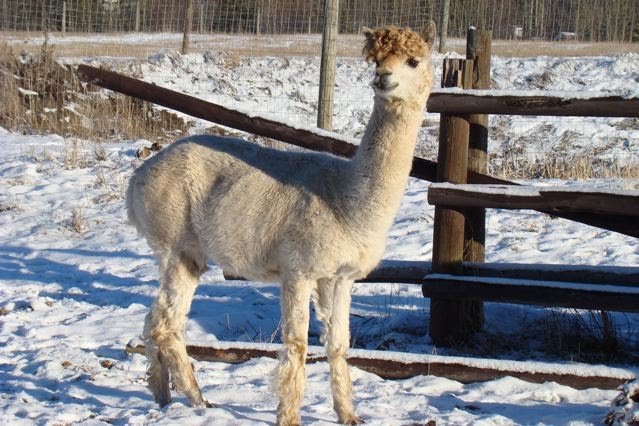
And so, for the past six months, I have had a dirty secret. Martin, the alpaca, is no longer where I placed him. And when I heard he was about to be moved again, I did not take him back.

Sh*t happens. Lives fall apart. Situations change. And so it was with Martin.

For those unfamiliar with Martin's story, I'll provide a brief summary:

In 2006, I rented some acreage in Mission, BC where Martin had been abandoned in the back field. He had been there for 6 – 8 years, all by himself. From neighbours, I learned he had been purchased as a newly-weaned cria by a former tenant, who then left him behind when they moved out a year later. Subsequently, some renters had fed him, most had not. He had no shelter except for a tree, under which he had dug a dirt hole. He lived with coyotes and bears roaming through the field, as well as the occasional pack of dogs. It was cold and snowy in winter, very wet in fall and spring, and hot in summer, yet he survived it all.

I named him Martin after Saint Martin de Porres, a Peruvian saint who was said to be able to communicate with the animals. It was a fitting name as alpacas are a Peruvian animal, and Saint Martin de Porres, from what I have read of him, embodied many of the qualities that I admire, and shared Martin the alpaca's gentle temperment.

I built Martin a good shelter, made sure he had fresh water, grains and hay all year, had him shorn (he had never been done!) and his toes and teeth done, had him gelded, and taught him to come when called and to eat from my hand. He shared the pasture with the potbellied pigs I fostered, socialized with llamas in an adjacent field, and became comfortable around me and my dogs.


I knew I would not be on that property for more than a few years – retirement was looming, and the rent was too high for me to afford on my pension. Nor would I have the finances to buy acreage of my own. But I could not, in good conscience, walk away from him at the end of my lease. I persuaded the landlord to sign him over to me so that I could find Martin a home.

When I was about to retire, in 2009, I put the word out via rescue forums and alpaca organizations to find him a new home. A kind woman on Vancouver Island, who has an assortment of rescue animals, and also a herd of alpacas from which she collects the fibre for weaving, offered to take him in - a bonus for me as the community to which I was retiring was coincidentally about twenty minutes away from her farm, allowing me to continue to see Martin. Another rescue person and I did a homecheck, talked with her about our expectations, and met her other animals. The woman came to Mission to pick up Martin, and he rode home in comfort in the back of her van. Martin had a home.


I visited him there several times. Martin had settled in well, becoming "Uncle Martin" to the crias, and learning how to truly be an alpaca. I thought my work was done.


And then, last spring, I received an email from Martin’s new mama to say that ill health was forcing her dear friend and business partner to reconsider her participation in the care of the herd, and in the final shakedown, some of the animals would have to be rehomed. While I was not happy to hear this, I did understand – and I have a huge respect for animal caregivers who recognize their own physical and financial limitations. I see and hear of so many rescues/rescuers who lack the ability to recognize when they are overextended, and ultimately it is the animals who suffer.

As the person responsible for Martin’s initial rescue, many would say I should have taken him back and found him another home. The email came right at the time that my two shelties died just a week apart, and my mom had a medical crisis, and it was simply not possible for me to house him on my small village lot. And I was confident that Martin’s new mama shared the same values as I for selecting where he should go, and had a similar access to animal-loving networks. And so I stood back.

Sure enough, a person who does horse rescue offered to take on a small herd of alpacas, including Martin, and care for them while new homes were found. I was kept in the loop. The alpacas would only be placed in homes in pairs or more - no more lonely alpacas. I sponsored Martin to ensure his needs would be met, and just before Christmas received word that Martin and his best buddy Belvedere, a chocolate coloured senior alpaca, had been adopted by one of the horse rescue's foster homes.

So Martin is back on the mainland, this time in Northern BC, where he is being spoiled rotten by Serena and her family. Within days he was eating treats from her hand, coming up to the front fence to see what was going on, hanging out with the horses and ducks, and living the easy life.

He and Belvedere have a fenced pasture on which they can roam, a barn which they can go in and out of at will (their stall heated with infrared lamps in winter), and lots of attention. They each have their own feed bucket into which yummy grains are put each day – and then they both chow down from one bucket before both moving on to the second one. Silly alpacas!

Serena, his new mama, recently sent me these photos, and gave me permission to post them here.


I chose not to tell this story as it unfolded last summer because it was my dirty secret – I had failed to home Martin in a way that would ensure he would never lose a home again. But over the past few weeks, I decided that I will share his story, because I believe it is worth the telling. I still have no patience for people who adopt animals and then decide for frivolous reasons not to keep them, who view them as property, as commodities, an inconvenience, who think that having a baby is reason enough to dump a dog. But I also recognize that sometimes in life, sh*t happens, and life turns upside down and inside out, and the four legged family members have their lives turned upside down too. Ideally, a stable life where the whole family, human and animal, remain together is usually in each member's best interest, but sometimes it cannot be.

What is important, I think, is to ensure that the animal - whether dog or pig or alpaca or bird or pet rat - is provided with a secure environment, with good food, with fresh water, with companionship .... and with love. And that is something Martin has. He is a content, happy alpaca who has finally found his home. Thank you, Serena, for welcoming Martin and Belvedere.


For more stories on Martin's life with me and his transition to the alpaca herd on Vancouver island, check out some of these earlier posts:

Mischievous Martin, Pesky Pigs and Three Dawdling Dogs

Hey, Who Stole Martin?

The Grass is always Greener

An Alpaca gets the Zoomies

Martin

The Odd Couple

A Herd of His Own

Martin's Big Snip - Part One

Martin's Big Snip - Part Two

Martin's Big Snip - Part Three

And then there were none

Nekid 'Pacas!

Fun at the Farm

Tuesday, March 30, 2010

Airplanes, Teens, and Animal Rescues

When I was about 14 years old, I overheard my father and my friend’s father discussing an incident in which the behaviour of a few teens had disrupted the community. The local paper was full of letters to the editor condemning youth en masse, and my friends and I were pretty upset at being lumped in with the losers who had dragged bales of hay into an intersection and set them on fire on Hallowe’en night. (Okay, this may seem tame by comparison to some of today’s hijinks, but in a small town in the 60s, this was BIG news!) Our dads were discussing this, and my friend’s dad made a statement that has stuck with me for over forty years: “Teenagers are a lot like airplanes – you only hear about the ones that crash.”

Whenever I feel like I cannot watch another newscast, read about another scandal, or deal with another pessimistic person, I think of that statement. We are bombarded with bad news stories, and while there are a few “fluff” pieces of feel-good news, we lose perspective when we give so much attention to the negative and so little to the positive.

While I am in no way recommending we ignore social injustice or the truly horrible things that occur in human society, I think it serves us well to try to balance the horrible with those acts worthy of applause.

Yesterday, Hearts on Noses rescued yet another pig – they are stretched to the limit yet this one little (or rather, BIG) potbellied pig, with ears and tail bitten off by rats that shared its terribly inadequate and horrific living conditions, is now sleeping safely and comfortably at the sanctuary. Yes, we could focus on the abhorrent acts of the person who had responsibility for this pig –and I certainly believe he should be criminally charged – but if we dwell solely on the negative we will forget to celebrate the positive. And so I invite a mighty cheer and a standing ovation for Janice at Hearts on Noses, and for the others who brought the pig to her attention and helped with the rescue. There is one fewer animal being tormented tonight.

My friend’s dad’s phrase came to mind also when I was browsing through some of the animal rescue** blogs and forums I read from time to time. Ongoing wars, backstabbing, rescues fighting with rescues, rescues being exposed as brokers or as neglecting animals in their care, rescues that run amuck and lose sight of their original purpose – the stories are numerous, the knee-jerk reactions many.

The fact that rescues argue among themselves about such things as ethics, animal welfare, and policies and procedures is, in my opinion, an excellent thing. Such issues need to be debated and critically evaluated by people who are in the thick of it. But the fact that all rescues sometimes get branded negatively when one rescue is exposed as a broker or as neglecting its charges or when an organization makes what proves to be an unpopular decision, is, to me, the parallel of seeing only the plane that crashes and not the many safe landings that occur every hour of every day.

In my internet browsing today, I came across an attack on an organization for which I am a proud volunteer – the SPCA. One branch of the organization made a decision regarding an animal, a decision which was based on their best information, veterinary advice, resources, and sense of what was manageable for them, at that point in time……and that decision was vigorously debated by various rescue groups and individuals. One group in particular, which devotes a considerable section of its website to derogatory commentary about the SPCA, publicly attacked not only the SPCA’s recent decision but also anyone from other organizations who dared to voice support for the SPCA.

All animal rescue organizations make unpopular decisions from time to time. All animal rescue organizations have to face financial and human resource realities. All animal rescue organizations have “planes that crash”. But when it comes to the SPCA, I can think of no organization that on such a wide-spread basis does so much in this province to educate the public, to provide care for animals, to confront issues of cruelty and neglect, all on the same non-profit, donation-based budget as every other rescue organization.

Every day, at the SPCA shelter near me, every dog gets walked. Every Single Day. Every day, at the SPCA shelter near me, every dog receives personal attention. Every Single Day. Today, a dog whose penis had been virtually ripped off received his reconstructive surgery, another went in for her spay, a third was hopping around the office while she recuperated from surgery to fix internal injuries caused by someone’s boot. There isn’t a week goes by that my heart isn’t touched by the survival stories of animals in the SPCA’s care, and that I don’t feel a deep, deep gratitude to the staff and volunteers at my SPCA and at others all over the province.

Animal rescues are a lot like airplanes – you only hear about the ones that crash. It’s time to recognize the everyday successes, the thousands of animals who are helped every day and the thousands of people who help them. It’s time to acknowledge and celebrate safe landings.

To do anything less is to lose sight of the reality.


**( Note: I use the word 'animal rescue' very broadly in this entry, to encompass all not-for-profit groups and individuals who help bring animals to safety - from the individual working out of their home to foster, train, vet, and place in appropriate homes dogs that no one wanted, to community-based shelters that take in strays and owner-surrenders, to the province wide organizations like the SPCA who work on a much broader and more public level.)